Best AI Tools for M&A Professionals in 2026 (and How They Differ)

Best AI Tools for M&A Professionals in 2026 (and How They Differ)

If you're an M&A advisor still building buyer lists in Excel or filtering through PitchBook's same 500 results, you've probably noticed something: the gap between what traditional databases deliver and what your deals actually need is getting wider.

The lower and middle market doesn't work like large-cap M&A. Your targets aren't filing 10-Ks. Your buyers aren't always in the obvious databases. And the companies you're trying to map—whether it's a $12M niche distributor or a regional SaaS player with seventeen competitors—require research that keyword filters simply can't handle.

As we move into 2026, the gap between legacy data platforms with light AI layers and true AI-native sourcing tools is widening rapidly.

That's where AI tools have started to matter. Not the "AI-powered" marketing claims every platform now slaps on their homepage, but actual pattern recognition, adjacency detection, and agentic research that surfaces companies and relationships legacy systems miss.

This isn't a comprehensive guide to every tool claiming AI capabilities in M&A. It's a practical breakdown of what different categories of tools actually do, where they fit in your workflow, and—most importantly—which ones help with the hardest part of the job: finding the right companies in the first place. While AI-native sourcing tools are driving the biggest shift in origination, other systems—especially diligence, legal review, and workflow automation tools—are reshaping downstream deal execution.

What Makes a Tool "AI-Driven" in M&A (vs. Just Marketing)

Before diving into specific tools, it helps to distinguish real AI functionality from database features that got rebranded.

Real AI features in M&A tools include:

  • Pattern recognition across unstructured data: Identifying companies based on behavior, not just stated attributes
  • Adjacency detection: Surfacing non-obvious competitors, acquirers, or targets based on operational similarities
  • Behavioral signals: Analyzing hiring patterns, technology adoption, geographic expansion, or M&A activity
  • Ranking and reasoning logic: Not just returning results, but explaining why a company is relevant
  • AI agents: Autonomous research that iterates, validates, and refines without manual prompt engineering

Not AI (but often marketed as such):

  • NLP-enhanced keyword search
  • Filter combinations on structured datasets
  • Auto-suggestions based on historical user behavior
  • Basic document OCR or data extraction

The distinction matters because middle-market deal teams don't have time to test every tool. You need to know if a platform will actually find companies you wouldn't have found otherwise, or if it's just a faster way to search the same limited dataset. Because AI tools evolve rapidly, the most valuable approach is understanding the categories and workflows they support, not relying on a static list.

Taken together, these AI tools support the full M&A lifecycle—origination, research, diligence, and execution.

Category Examples Best For
AI Sourcing & Research PrivSource, Factsheet, Deliverables.ai Buyer discovery, target mapping, AI-agent driven origination
AI-Enhanced Databases Grata, inven.ai, Diligent, Thomson Reuters Structured data search, thematic queries, company lookups
Due Diligence AI Kira, eBrevia, Imprima, ThoughtRiver Contract review, risk identification
Workflow AI ChatGPT, Claude, Superhuman, Affinity Email, summaries, CRM intelligence

Category 1: AI-Driven Deal Sourcing & Research Tools

This is where AI has made the biggest practical difference for deal teams—particularly for origination, buyer discovery, and target mapping in fragmented markets.

PrivSource

PrivSource is built specifically for lower and middle-market deal sourcing with two core products: a Buyer List tool (sell-side) and a Target List tool (buy-side). Both use AI agents to discover, rank, and enrich potential buyers or targets beyond what traditional databases surface. Tools like PrivSource help advisors automate the first 70% of buyer discovery by surfacing and ranking relevant acquirers with reasoning, which is particularly useful when working in niche verticals where obvious strategic acquirers don't exist in the usual datasets.

Factsheet

Factsheet combines AI-driven company intelligence with workflow automation for deal teams. It's designed to help advisors build and maintain target lists, track companies over time, and generate research outputs. The platform uses AI to enrich company profiles and surface relevant insights from unstructured sources.

Best for: Teams that need ongoing intelligence on a defined universe of companies—useful for buy-side origination where you're monitoring a sector over months, not just building one-off lists.

Deliverables.ai

Deliverables focuses on using AI to generate CIMs, company profiles, and deal marketing materials. It's not a sourcing tool in the traditional sense, but it's relevant here because it automates a significant portion of the research and writing work that comes after you've identified targets or buyers.

Best for: Sell-side teams that need to produce polished company profiles or pitch materials quickly. Less relevant for pure origination work.

[LINK: AI Deal Sourcing Article]

ChatGPT / Claude / Perplexity / Copilot (as Sourcing Copilots)

This might seem obvious, but many advisors underestimate how useful general-purpose LLMs are for deal sourcing research—particularly when combined with web search or used iteratively.

How advisors actually use them:

  • Adjacency mapping: "What types of companies acquire regional HVAC distributors?" or "Who are the strategic acquirers for B2B SaaS companies serving dental practices?"
  • Market structure research: Building initial hypotheses about fragmented markets before deeper sourcing
  • Triage and validation: Quickly researching unfamiliar companies or verifying if a potential buyer is plausible
  • Prompt-based list building: Iteratively refining company lists based on specific operational criteria

The key is treating these tools as research assistants, not complete sourcing solutions. They won't give you a ranked buyer list with contact information, but they'll help you think through adjacencies, validate hypotheses, and map market structures faster than manual research.

Best for: Early-stage research, hypothesis generation, and filling knowledge gaps. Most useful when you already know how to think about a market and just need faster iteration.

A Note on Diligence-Focused AI Tools

It's worth acknowledging that a significant portion of AI tools in M&A focus on due diligence, legal review, compliance, and document analysis—not origination. Platforms like Kira, eBrevia, Imprima, Compliance.ai, ThoughtRiver, and DealRoom AI are designed to accelerate contract review, risk identification, and deal execution workflows. These tools are incredibly valuable during diligence and closing, but they don't help you find companies or build lists. In 2026, expect sourcing AI and diligence AI to diverge even further—one focused on discovery and intent signals, the other on document intelligence and execution. We'll cover them in more detail in Category 3.

A Note on Workflow & Productivity AI

Similarly, many advisors now use AI copilots and productivity tools—ChatGPT, Claude, Perplexity, Copilot, Superhuman, Affinity, and Salesforce Einstein—to support research, communication, and analysis. These tools help with drafting emails, summarizing documents, managing relationships, and accelerating routine tasks. They're complementary to sourcing platforms, not replacements. An LLM can help you think through adjacencies or draft an email to a potential buyer, but it won't build you a ranked list of 50 acquisition targets with validated contact information. 2026 will also bring the first practical versions of multi-agent sourcing workflows, where research, enrichment, and outreach agents collaborate autonomously across a deal team's pipeline. We'll cover these in Category 4.


Category 2: AI-Enhanced Databases (Structured Data with NLP Layers)

These platforms have added AI-powered search or analysis features, but they're fundamentally structured databases. They're valuable for what they do well—comprehensive coverage of public companies, well-documented transactions, and reliable financials—but they're limited for sourcing in markets where coverage is thin.

Grata

Grata is one of the more established AI-enhanced databases, particularly strong for middle-market private company search. It uses machine learning to classify companies based on what they actually do (parsed from websites, job postings, news) rather than relying on SIC/NAICS codes. The search interface is intuitive, and the company descriptions are generally accurate.

Best for: Building target lists when you need to go beyond standard database filters. Particularly useful for thematic searches (e.g., "companies selling to dentists" or "B2B marketplaces in industrial distribution").

Limitation: Still primarily a search and database tool. It won't build you a complete buyer list with reasoning and ranking, but it will help you find companies you didn't know existed.

inven.ai

inven.ai focuses on private company intelligence and buy-side sourcing within a database framework. It uses AI to identify companies based on operational characteristics rather than just industry codes. Strong for mapping fragmented markets where you're looking for companies that behave a certain way (e.g., growing regional players in home services, B2B SaaS companies expanding into specific verticals). The platform's strength is pattern detection across unstructured signals—hiring data, technology stack changes, geographic footprint expansion.

Best for: Buy-side teams looking for hard-to-find targets in markets where legacy databases have poor coverage.

Diligent

Diligent (formerly Naviga) offers AI-enhanced search across a database of public and private companies, with NLP-powered query capabilities. It's useful for navigating large datasets more intuitively, but it's still constrained by what's in the database. If a company isn't tracked by Diligent, the AI layer won't magically find it.

Best for: Teams that need better search functionality within structured datasets. Less useful for discovering truly unknown companies.

Thomson Reuters Document Intelligence

Thomson Reuters has integrated AI-powered document analysis and search into its data platforms. Strong for analyzing public filings, news, and regulatory documents at scale. The AI functionality is more about analyzing and extracting insights from known data sources than discovering new companies.

Best for: Large deals with extensive public information. Less relevant for lower middle-market sourcing where public data is sparse.

PitchBook / CapIQ / Refinitiv / CB Insights

These platforms have added various AI-powered features (better search, automated alerts, natural language queries), but they remain fundamentally structured databases. They're essential for transaction comps, valuation research, and tracking known companies, but they're not designed for discovering companies that aren't already in their coverage universe.

Reality check: If you're working in the lower middle market and searching for private companies in niche verticals, these tools will give you the same 200-500 results every time, regardless of how you refine your filters. That's a data coverage problem, not a search problem, and AI search features don't solve it.


Category 3: AI Tools for Due Diligence & Legal Review

These tools are incredibly useful during execution, but they're not sourcing tools. They're designed to accelerate document review, contract analysis, and diligence workflows once you're already in a deal.

Kira (kira.ai)

Kira is one of the most established AI-powered contract review platforms. It uses machine learning to identify and extract key provisions from contracts, leases, and legal documents. Particularly strong for diligence on companies with large contract portfolios (e.g., commercial real estate, enterprise software).

Best for: Buy-side diligence teams reviewing hundreds of contracts. Saves significant time on extracting specific provisions (change of control, termination, pricing, renewal terms).

eBrevia (Dfin)

eBrevia is Donnelley Financial Solutions' AI-powered contract analysis platform. Similar functionality to Kira—automated extraction of key terms, clause identification, and risk flagging. Often used in legal due diligence for M&A, real estate, and lending transactions.

Best for: Legal teams conducting contract review at scale.

Imprima

Imprima (now part of Datasite) offers AI-enhanced virtual data room functionality with automated document classification, redaction, and Q&A tools. More of a workflow platform than pure contract analysis, but the AI features help structure and navigate diligence processes.

Best for: Managing diligence workflows, particularly in cross-border or complex transactions.

ThoughtRiver

ThoughtRiver focuses on pre-signature contract review, using AI to flag risks and non-standard terms before contracts are finalized. More relevant for procurement and legal ops teams than M&A advisors, but useful in specific diligence contexts.

compliance.ai

compliance.ai uses AI to track regulatory changes and analyze compliance risk. Useful in heavily regulated industries where regulatory exposure is a key diligence item (financial services, healthcare, energy).

DealRoom AI

DealRoom has integrated AI features into its project management and pipeline tracking platform. Includes automated diligence request tracking, document categorization, and workflow intelligence. More of a deal execution platform than a sourcing tool.

Best for: Managing multiple deals simultaneously, particularly for teams that need structured workflows and tracking.


Category 4: AI Workflow, Productivity & Collaboration Tools

These tools don't directly help you find companies, but they make the day-to-day work of deal execution significantly faster.

Superhuman

Superhuman's AI-powered email workflow is designed for speed. For deal professionals drowning in email—tracking outreach, following up on intros, managing NDAs and LOIs—it's legitimately useful. The AI features (auto-categorization, suggested replies, send-later optimization) save time on email management, which is a real cost for busy advisors.

Best for: Professionals who spend 2+ hours daily in email. Not M&A-specific, but the time savings compound.

Affinity

Affinity is relationship intelligence software that uses AI to track and surface connections. It automatically logs email and calendar interactions, suggests warm introductions, and identifies relationship strength. Particularly useful for deal teams that rely on networks for sourcing and introductions.

Best for: Origination teams that source through relationships. Strong for tracking who knows whom and leveraging warm intros for buyer or target outreach.

ChatGPT / Claude / Perplexity (as Workflow Assistants)

Beyond sourcing research, these tools are increasingly used for:

  • Drafting and editing: IOIs, teasers, NDAs, email templates
  • Summarization: Condensing research, meeting notes, or market intelligence
  • Analysis: Quickly parsing financials, identifying trends, or structuring data

The productivity gains are incremental but real. Most advisors now use LLMs daily for routine writing and research tasks.

Salesforce Einstein / HubSpot AI

If you're using a CRM, the AI features (predictive scoring, automated task creation, smart recommendations) can help prioritize outreach and surface warm opportunities. More relevant for business development and origination teams than execution-focused advisors.


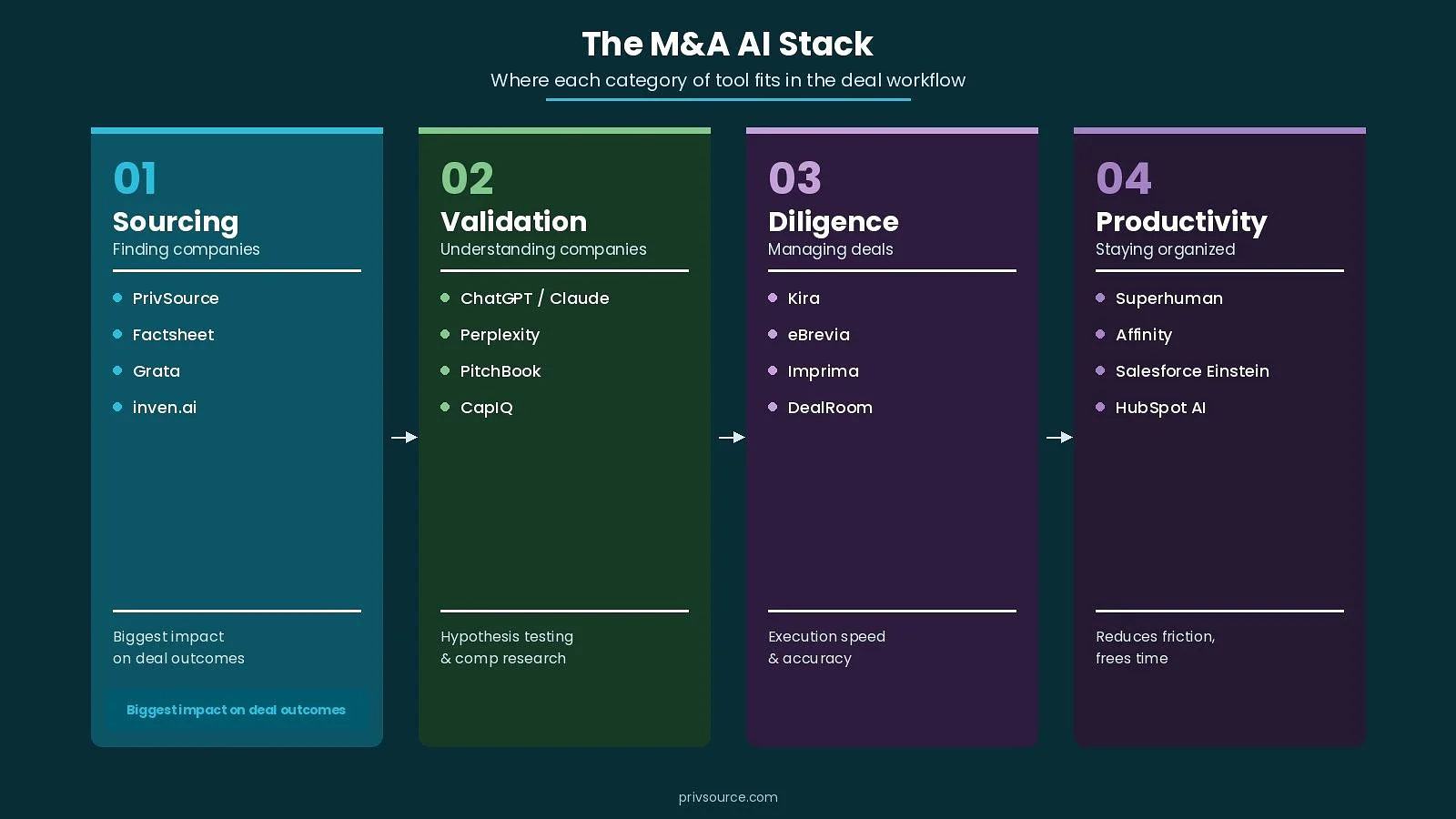
How to Think About Building Your AI Stack

The mistake most deal teams make is trying to find one tool that does everything. That tool doesn't exist.

Instead, think about your workflow in stages:

1. Sourcing & Research (Finding Companies)
This is where AI-native tools like PrivSource, Grata, and inven.ai add the most value. If you're still relying entirely on traditional databases for origination, you're missing companies—especially in fragmented, lower-middle-market sectors.

2. Validation & Triage (Understanding Companies)
This is where LLMs (ChatGPT, Claude, Perplexity) and traditional databases (PitchBook, CapIQ) complement each other. Use AI copilots for fast research and hypothesis testing. Use structured databases for comps and transaction history.

3. Execution & Diligence (Managing Deals)
This is where contract review tools (Kira, eBrevia), workflow platforms (DealRoom), and document intelligence (Thomson Reuters) become essential. These tools save time during diligence, but they don't help you find deals in the first place.

4. Productivity & Relationship Management (Staying Organized)
This is where email AI (Superhuman), relationship tracking (Affinity), and CRM intelligence (Salesforce Einstein) reduce friction. They won't close deals for you, but they'll free up time for higher-value work.

The key is understanding which tools solve which problems. Don't expect a diligence tool to help with sourcing, and don't expect a sourcing tool to review contracts.


What's Still Missing (and What's Coming)

Even with all these tools, there are gaps:

Better integration across platforms. Most advisors still copy data between tools manually. Real workflow improvements will come when sourcing platforms, CRMs, and diligence tools talk to each other seamlessly.

More sophisticated buyer matching logic. Current tools are good at finding plausible buyers, but less good at predicting motivated buyers. The next generation of tools will incorporate more behavioral signals—active acquisition patterns, financing activity, executive hiring—to surface buyers who are actually in-market.

Agentic workflows that learn over time. Most AI tools today require you to start from scratch each time. Tools that learn from your past searches, deals, and preferences will be significantly more useful.

Better coverage in international markets. Most AI sourcing tools are strongest in the U.S. Coverage in Europe, APAC, and emerging markets is still limited.


Final Thoughts

The AI tools that matter most for M&A professionals in 2026 are the ones that solve the hardest, most time-consuming parts of the job: finding companies that fit specific criteria, understanding fragmented markets, and automating repetitive research.

For deal teams in the lower and middle market, that means prioritizing tools that expand your sourcing reach—platforms that surface companies traditional databases miss, that understand adjacencies and behavioral patterns, and that help you build defensible lists faster. That said, legal and diligence AI tools are fundamentally reshaping how teams execute deals once they're sourced, and workflow AI is materially improving day-to-day productivity across the entire deal lifecycle.

The real leverage comes from better sourcing.

If you're still building buyer lists manually, or if you're relying on the same tired database filters, it's worth testing the AI-native sourcing platforms. The market has changed. The tools have changed. Your sourcing process should change too.

[LINK: AI in M&A Pillar]
[LINK: AI Deal Sourcing Article]
[LINK: Buyer List Guide]

Ready to improve your buyer outreach?

Try AI Researcher for Free

No credit card required. Cancel anytime.