To find strategic acquirers, start with the reason a company would buy your client, then pull names from five sources: public acquisition announcements, M&A databases such as PitchBook, Grata, and SourceScrub, the seller's own customer and supplier lists, trade association member directories, and AI buyer-list tools. Record one piece of evidence per name and verify it before outreach.
Start with the reason to buy, not an industry code
Most strategic lists fail because they begin with an industry filter. A company can look like a buyer and have no reason to buy.
Ask instead what changes for the acquirer. Does it gain customers it cannot reach, a service it cannot deliver, a location it cannot cover, or a sales channel it does not have?
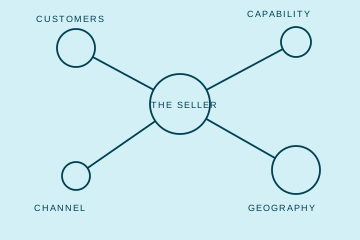
Suppose your client is a regional inspection business with field technicians and recurring compliance contracts. Other inspection firms are the obvious buyers. Equipment service companies, compliance advisers that outsource inspections, and sponsor-backed platforms that need a local field team are the better ones.
The non-obvious buyers that win deals come from this question, not from a database filter.
Which tools find strategic acquirers?
Five sources do most of the work. Use them in this order.
- Public acquisition announcements. A press release or 8-K tells you who bought what and the stated reason. Search SEC EDGAR full-text search for public acquirers. Private acquirers never file, so read trade press and acquisition announcements by industry. Cover the last 24 months. The stated reason is the acquirer telling you its thesis.
- M&A databases. PitchBook, Grata, and SourceScrub filter private companies by keyword, size, ownership, and deal history. They are per-seat subscriptions, and they are thinnest on small family-owned companies that never announce anything. Use them to expand a thesis, not to generate one.
- The seller's customer and supplier lists. Ask the owner for the top 20 customers and top 10 suppliers. A customer that spends $1M a year with your client has a reason to own it. A supplier that sells through your client has a reason to buy the channel. This is the cheapest source and the one advisors skip.
- Trade association member directories. Most industries have an association with a member directory sorted by region and service. It lists the private companies the databases miss. Pull every member two to five times the seller's size in adjacent regions.
- AI buyer-list tools. Give the tool a deal description and it returns candidates with a reason each one fits. Treat the output as a research draft, not a finished list.
Record one piece of evidence per name
One acquisition announcement is a lead, not a current mandate. For each name, write down where it came from and what supports the match.
Strategic acquirer worksheet
- Company and owner. Record a sponsor-backed operating company and its sponsor as two rows. The team that sees the benefit may not control approval.
- Source. Announcement, database, customer list, directory, or AI tool.
- What the seller adds. One capability, customer group, location, or channel. "Both are in business services" does not count.
- Evidence. The URL and the date you checked it.
- Statement or inference. Mark whether the company said it or you concluded it.
- What could rule it out. Ownership change, seller exclusion, or an integration in progress.
- Next action. Call, one more hour of research, or park.
Twenty names with a filled evidence column beat 80 names with a blank one. Once the column is filled, rank the list by reason to buy and ability to pay, not by size.
Keep research separate from outreach
Before you contact anyone, ask the seller for a do-not-contact list: competitors, customers, and suppliers who must not learn about the sale. Keep those names on the research list and off the outreach list. A match the seller vetoes still tells you what kind of buyer to look for.
Then decide the next action per name. Some need a call. Some need another hour of research.
A longer list is not a better one. A list where every name has a reason and a source is.
Where PrivSource fits: AI Buyer List takes a deal description and returns strategic and financial buyer candidates with a fit reason for each one, drawn from acquisition history and company profiles. It fills the evidence column faster than manual search. You still verify each reason against the source before the name goes to the client.