The lower middle market (LMM) is the group of private companies larger than Main Street businesses and smaller than the middle market. Sources draw the lines in different places. IBBA and M&A Source use $2 million to $50 million of enterprise value, while Axial uses $5 million to $250 million of revenue and $500,000 to $25 million of EBITDA. In PrivSource data, the median business listed for sale had $922,000 of cash flow and $4.4 million of revenue.
How do the main sources define it?
| Source | Lower middle market | Measured by |
|---|---|---|
| IBBA and M&A Source Market Pulse | $2M to $50M; under $2M is Main Street | Enterprise value |
| Axial | $5M to $250M of revenue, $500K to $25M of EBITDA | Revenue and EBITDA |
| Capstone Partners | $10M to $250M | Enterprise value |
| PitchBook | "Often" as low as $10M; the middle market starts at $25M | Company value and PE backing |
Sources: the Q2 2026 Market Pulse, Axial, Capstone Partners, and PitchBook, checked November 12, 2026.
The four sources overlap, but they do not agree. Capstone Partners starts at $10 million of enterprise value and goes up to $250 million. PitchBook says the range often starts as low as $10 million, and it puts the start of the middle market at $25 million. Axial measures a company by its revenue and EBITDA instead of its enterprise value. When someone calls a company lower middle market, ask which of these measures they mean.
The Market Pulse also reports prices for the two groups in different terms. It reports deals under $2 million as a multiple of seller's discretionary earnings, and deals from $2 million to $50 million as a multiple of EBITDA.
How big are the businesses that are actually for sale?
Most of them are smaller than these definitions suggest. The table shows businesses that brokers, M&A advisors, and bankers listed for sale from August 17 to November 12, 2026, in PrivSource data. The cash flow below is the figure each listing stated, which can mean EBITDA or seller's earnings.
| Cash flow stated in the listing | Share of listings |
|---|---|
| Under $1 million | 45% |
| $1 million to $3 million | 24% |
| $3 million to $5 million | 8% |
| $5 million to $10 million | 6% |
| $10 million or more | 2% |
| Not stated | 15% |
The median stated cash flow was $922,000, and the median stated revenue was $4.4 million. Only 40% showed $1 million or more, and $1 million is the usual minimum for independent sponsors, family offices, search funds, and PE groups. So a buyer with that minimum has to see a lot of listings to find the ones that are large enough.
The listings are also spread across many advisors. The ten advisors with the most listings posted only about a third of them, and many advisors posted just one in three months.
Which industries have the most deals?
Among listings with $1 million or more of cash flow, trades and industrial businesses lead. These are the six largest groups.
| Industry | Listings with $1M+ cash flow |
|---|---|
| Specialty trades and contracting | 73 |
| Manufacturing and industrials | 48 |
| Healthcare | 46 |
| Consumer products and retail | 44 |
| Business and professional services | 38 |
| Technology | 37 |
Who buys lower middle market companies?
Seven kinds of buyer are active, and each one looks for a different size of company. On PrivSource, a mandate is a buyer's written description of the companies it wants to buy. The table shows each kind of buyer's share of the mandates on PrivSource in November 2026.
| Buyer type | Share of mandates | Median EBITDA range |
|---|---|---|
| Independent sponsor | 22% | $1.0M to $5.5M |
| Individual investor | 22% | $0.5M to $2.0M |
| Family office | 11% | $1.0M to $5.0M |
| Search fund | 10% | $1.0M to $5.0M |
| Private equity group | 10% | $1.0M to $15.0M |
| Corporate (strategic) acquirer | 10% | $0.75M to $5.0M |
| Holding company or family business | 7% | $0.5M to $3.0M |
Individual investors crowd the small end: about three in four of their mandates would include a business with $1 million of EBITDA. At $5 million, independent sponsors lead, followed by family offices and PE groups. To see how sponsors and searchers differ, read independent sponsor vs search fund.
Which buyers look at each size?
The size of a business shapes who buys it and how the sale runs. Above $1 million of cash flow, buyers get a confidential information memorandum (CIM), the full write-up of the business, after they sign an NDA.
| Cash flow | Who buys | How the sale usually runs |
|---|---|---|
| Under $1M | Individual investors, self-funded searchers, holding companies | Listed by a broker, priced on seller's earnings, often paid for with an SBA 7(a) loan up to $5M |
| $1M to $3M | Search funds, independent sponsors, family offices, individuals | Sold by a broker or small investment bank, with the CIM sent after an NDA, priced on EBITDA |
| $3M to $10M | Independent sponsors, PE groups, family offices, strategic buyers | Run by a banker, with a CIM, a first round of bids, and then a letter of intent |
| $10M and up | PE groups and strategic buyers | An auction run by a banker, often in two rounds |
The loan limit comes from the SBA. If you are a buyer, set your minimum size knowing that most listings are below $1 million of cash flow. For the buyers active at one size, see private equity buyers for a $3M EBITDA company. For places to look, see where to find private businesses for sale.
Where PrivSource fits
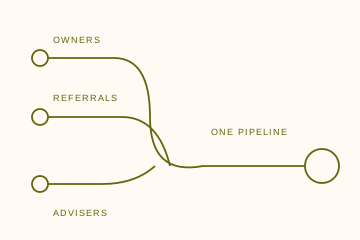
PrivSource charges buyers $299 a month and never charges a success fee. Our AI sourcing agent checks broker, M&A advisor, and banker websites every day for companies that match what you want to buy. That includes the many small advisors who post one deal a quarter. Advisors also send us deals that are not posted anywhere, and we bring them to you when they match. Telling us what you want to buy is free. Apply for buy-side access.