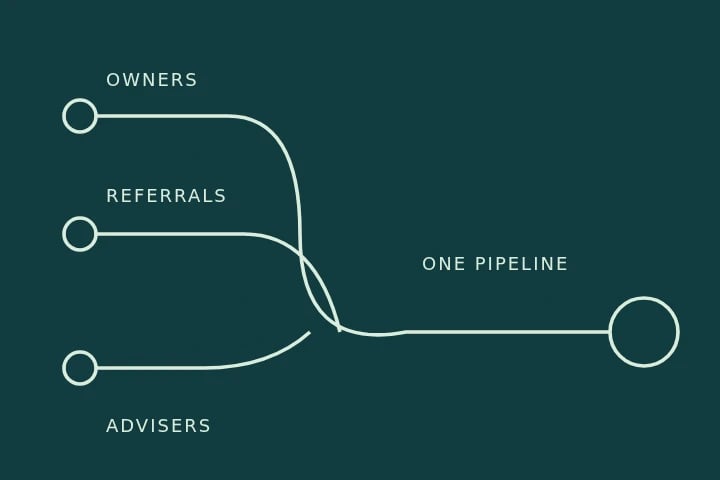
Family offices that buy companies directly use four kinds of tools: a deal network such as Axial for companies that M&A advisors are selling, a database such as Grata or PitchBook to find owners to write to, a CRM such as Affinity, and services that find broker and advisor deals that match what you want to buy. Start with one source of deals and one CRM. Buy a database only when someone will write to owners every week.
How much do family offices invest directly?
Family offices put about 8% of their portfolios into direct private equity, according to the UBS Global Family Office Report 2026, which surveyed 307 family offices. That was the share in 2025, and the offices plan to keep it at 8% in 2026. U.S. family offices held 10%.
Brokers are seeing family offices more often. In BizBuySell's Q3 2026 Insight Report, 20% of brokers said they saw more family offices than a year earlier.
On PrivSource, the median family office is looking for companies with $1 million to $5 million of EBITDA, and about two in three include a company with $5 million of EBITDA in their range (PrivSource data, November 2026). Search funds ask for the same median range, so expect other buyers to want the companies you want.
How do the tools compare?
| Tool | What it does | Price for buyers |
|---|---|---|
| Axial | Teasers from M&A advisors, up to $25M EBITDA | No subscription; success fee on deals first seen there |
| Grata | Searches 22M+ companies; its Growth plan lists family offices | Not published |
| PitchBook | 12.7M+ companies and 3.1M+ deals | Not published; quoted by seats and firm type |
| Affinity | CRM that records your emails and meetings with advisors and owners | $2,000 to $2,700 per user per year |
| BizBuySell | Public listings; Q3 2026 median sale price $350,000 | Free; Edge from $20 a month |
| PrivSource | Deals from broker and advisor websites, plus deals advisors send us | Free to start; $299 a month; no success fee |
Sources: each vendor's own site, checked November 12, 2026.
When is a deal network better than a database?
A deal network is better when you want a company that is already for sale. On a network like Axial, M&A advisors who are selling a company send buyers a short summary of it, called a teaser. A database such as Grata finds companies by what they do, but most of those companies are not for sale.
Axial charges no subscription. If you buy a company you first saw on Axial, you pay a success fee, which is $150,000 on a $5 million purchase. Our guide to what deal sourcing platforms cost works out the fee at three purchase prices.
A database makes more sense when the family already owns an operating company and wants to buy smaller companies to add to it. Then someone has to write to owners, and that takes one person's time every week.
When does a CRM matter more than more deals?
A CRM matters more when deals sit without a reply. In our experience, most family offices already see enough deals. They lose them because no one is responsible for answering the advisor.
Affinity costs $2,000 to $2,700 per user per year, billed annually. It records your emails and meetings with advisors and owners. Our guide to how family offices find direct investments includes a simple deal log you can use with any CRM.
What should you tell advisors?
Tell advisors three things: whether you buy control or a minority stake, who will run the company after you buy it, and how much money you have committed. Advisors send deals to buyers they can describe in one sentence.
Say the same three things everywhere. Your Axial profile, your emails, and anything else an advisor reads about you should agree. An advisor who reads two different versions will send you fewer deals.
Which tools fit the way you invest?
If you buy control of companies with $1 million to $25 million of EBITDA, use a deal network and one CRM, and add the success fee to every financial model. If you want to buy companies to add to a business the family already owns, get a database and give one person the job of writing to owners every week. If you plan to buy a single business for under $2 million, BizBuySell alerts and local brokers are enough. If you invest alongside private equity firms on their deals, skip the database and use a CRM to keep track of the firms you know.
Whatever tools you choose, name one person who answers every advisor within two business days.
Where PrivSource fits
PrivSource uses an AI agent to search broker, M&A advisor, and banker websites for companies that match what you want to buy. Advisors also send us deals that are not posted anywhere, for buyers whose criteria match.
Each deal comes with why it is worth a look and where it may not match. Telling us what you want to buy is free, the full search costs $299 a month, and members never pay a success fee. Apply for buy-side access.