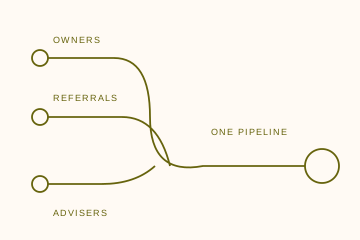
The best sources of proprietary deal flow are your own outreach to owners, advisors who already know your criteria, lenders and accountants, and your portfolio company CEOs. In a survey of 79 private equity investors, firms called almost 48% of their closed deals proprietary, and 35.6% were self-generated. Investment banks still brought in a third. Run all four sources every week, and measure first looks, not meetings.
What counts as proprietary?
A deal is proprietary when you are the only buyer, or one of a few, before a sale process starts. A teaser a broker emailed to 200 buyers is not proprietary, even if you saw it first.
Firms use the word loosely. In the Gompers, Kaplan, and Mukharlyamov survey of private equity investors, firms called 47.9% of closed deals proprietary "in some way." The authors add that they "have no way of evaluating exactly what proprietary means."
Use a stricter test for your own pipeline. Count a deal as proprietary only if no banker ran a process before your LOI.
Where do closed deals come from?
The same survey asked where each closed deal started. These are the mean shares across 71 firms:
| Source | Share of closed deals |
|---|---|
| Self-generated by the firm | 35.6% |
| Investment banks | 33.3% |
| Deal brokers | 8.6% |
| The firm's executive network | 8.6% |
| Inbound from management | 7.4% |
| Another private equity firm | 4.3% |
Smaller buyers report the same mix. In Axial's 2025 Independent Sponsor Report, 93.8% of sponsors used sell-side advisors and 82.5% used their own outreach. One sponsor put it this way: "Proprietary is the slowest, but has the highest probability and best fit."
Rank the five sources
- Direct outreach to owners. Build a list of companies that fit, then write to each owner. Searchers in the Stanford GSB 2024 Search Fund Study named databases and their own research as the main source of their acquisition.
- Advisors who know your criteria. Bankers and brokers call buyers they trust before a full process. Be the buyer who answers in a day.
- Lenders, accountants, and attorneys. They hear about a sale before anyone else does. Ask each one for one introduction a quarter.
- Your portfolio company CEOs. They know their competitors by name. Add-ons were 72.9% of U.S. buyouts in 2025, according to PitchBook data cited by Cherry Bekaert.
- Buyer-matching tools. Advisors who use them choose buyers by fit before the deal goes wide.
Expect a long funnel
Proprietary sourcing takes volume. The average firm in the Gompers survey looked at 100 opportunities to close 6. It investigated fewer than 24 and signed fewer than 14.
Search funds show the time cost. Stanford found that recent searchers signed 3.6 letters of intent on average, and the first came after 7.8 months. In its 2026 update, an acquisition took about 20 months.
Plan for a year of steady outreach before the first proprietary close. Our guide to how search funds find off-market businesses covers the owner letters.
Track first looks every week
Weekly proprietary sourcing scorecard
Source Touches Conversations First looks LOIs Owner outreach Advisors who know your criteria Lenders, CPAs, attorneys Portfolio company CEOs Buyer-matching tools A first look is a deal you saw before a process or a wide teaser. Cut a source that gives no first look in a full quarter. Double the source that gives the most.
For add-on targets in a portfolio company's own trade, use how to find add-on acquisition targets.
Where PrivSource fits
No tool makes a deal proprietary, but you can see more deals before they go wide. Our AI sourcing agent searches broker, M&A advisor, and banker sites for deals that fit your mandate, and advisors send us private deals for buyers whose mandate fits. In the 90 days to October 3, 2026, that came to 421 deals with $1 million or more of cash flow.
You see each deal with why it is worth pursuing and where it may be a stretch. Apply for buy-side access at no cost.