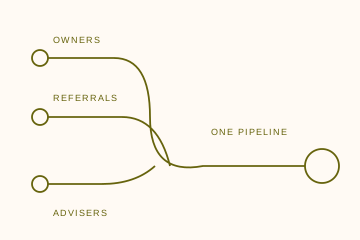
A search fund needs tools for four kinds of work. You need a list of companies and an email tool to write to owners directly, BizBuySell and DealStream alerts for businesses that brokers are selling, Axial for companies that M&A advisors are selling with $1 million or more of EBITDA, and Searchfunder to meet other searchers and investors. Most searchers who buy a company use three of the four.
How long does a search take?
Stanford GSB's 2026 Search Fund Study found that a searcher takes about 20 months to buy a company. Stanford's summary of the study says about half of the funds launched from 2021 to 2024 have bought one. Across every search fund in the study's history, 58% bought a company.
Searchers also face more competition for the businesses brokers sell. In BizBuySell's Q3 2026 Insight Report, 32% of brokers said they saw more search fund buyers than a year earlier.
Most searchers want companies of the same size, too. On PrivSource, the median search fund is looking for companies with $1 million to $5 million of EBITDA (PrivSource data, November 2026). So the tools worth your money are the ones that reach owners no other searcher has written to yet.
What does each tool do, and what does it cost?
| Tool | What it does | Price for buyers |
|---|---|---|
| Searchfunder | Community of searchers, investors, lenders, and brokers | Basic $4 a month; Professional $19 a month |
| Grata | Searches 22M+ private companies | Not published |
| Inven | Searches 65M+ private companies | Not published |
| Apollo | Finds owner email addresses and sends your emails | Free; Basic $49 a seat a month, billed yearly |
| BizBuySell | Public listings; Q3 2026 median sale price $350,000 | Free; Edge from $20 a month |
| DealStream | Public listings, with 18,000+ premium listings on Pro | Free; Pro $40 a month |
| Axial | Teasers from M&A advisors, up to $25M EBITDA | No subscription; success fee |
| PrivSource | Deals from broker and advisor websites, plus deals advisors send us | Free to start; $299 a month |
Sources: each vendor's own site, checked November 12, 2026.
How do you build a list of owners to write to?
A database of private companies is the fastest way to get names. Grata and Inven let you search private companies by what they do, but neither publishes a price. If you are self-funded, you can start for free with state business registries, trade association directories, and the lists of companies that exhibit at trade shows.
Searchfunder says more than 80% of people involved in search funds have an account there, and membership includes monthly credits for owner contact details. Once you have names, an email tool such as Apollo finds the addresses and sends your messages. Keep each letter short, and say something specific about the owner's company.
Our guide to how search funds find off-market businesses has a sample letter to owners and the reply rates you can expect.
When are broker listings better than writing to owners?
Broker listings are better when you need to buy a company this year. A business that a broker is selling comes with financial statements, an asking price, and an owner who has already decided to sell. Letters to owners face less competition, but owners reply slowly.
BizBuySell lists mostly small businesses, and its median sale price in Q3 2026 was $350,000. It also reports that sales above $1 million made up 22% of its deals, the highest share it has recorded. Set alerts for your industry and region, and reply to every broker the same day.
Is Axial worth it for a search fund?
Axial makes sense once you look for companies with $1 million or more of EBITDA. It lists search funds as one of its buyer types, and the M&A advisors on it sell companies with up to $25 million of EBITDA.
Axial does not charge buyers a subscription. Instead, if you buy a company you first saw on Axial, you pay a success fee, which comes to $150,000 on a $5 million purchase. Tell your investors about this fee before you sign a letter of intent. Our guide to what deal sourcing platforms cost works out the fee at three purchase prices.
Which tools should you start with?
That depends mostly on how your search is funded. If you are self-funded and look at companies under $2 million of EBITDA, start with free registries and association lists, Apollo, and alerts on BizBuySell and DealStream. If you run a traditional search fund aimed at $1 million to $5 million of EBITDA, add a database of private companies to find owners to write to, and use Axial for companies that advisors are selling.
In either case, keep a Searchfunder account and use it to meet investors and brokers. Keep every company you look at in one list, with a note on where you found it. Each Friday, count the replies that came from each source, so you know where to spend the next week.
Where PrivSource fits
PrivSource uses an AI agent to search broker, M&A advisor, and banker websites for companies that match what you want to buy. Advisors also send us deals that are not posted anywhere, for buyers whose criteria match.
Each deal comes with why it is worth a look and where it may not match. Telling us what you want to buy is free, the full search costs $299 a month, and members never pay a success fee. Apply for buy-side access.